

Vehicle Shoot Studio in London: How to Assess Reinforced Floor Capacity

Can a vehicle drive into a studio and still be too heavy for its floor? Absolutely. Vehicle shoot studio London reinforced floor capacity matters because drive-in access alone doesn’t show whether a floor can safely support a particular vehicle. The weight carried beneath the tyres creates local loads, which differ from weight spread evenly across a floor.
Before planning a shot, establish what the floor can support and whether the vehicle can reach its position safely. This guide explains the floor-loading details to assess, including distributed and concentrated loads, and how vehicle dimensions, turning space and production equipment affect your route. It also covers the information to gather before committing to a shoot, so your plan is based on details rather than assumptions.
Smashy Owl Studios offers a drive-in blackout studio in South London, near Oval, with professional lighting included at no extra cost. Here’s how to assess the structural and logistical requirements alongside the creative potential, and plan a vehicle production around the space.
Table of Contents
Choosing a Vehicle Shoot Studio in London: Why Floor Capacity Matters
A vehicle shoot needs more than a striking backdrop. The floor must suit the vehicle and production setup, and the route into position must work for the vehicle’s size and planned movements. Treat these as connected planning questions, but assess them separately: a straightforward entrance doesn’t establish what the floor can safely support.
Floor loading describes the load a floor is designed to support. For a shoot, consider how the vehicle’s weight reaches the floor, where it will be positioned and whether it will move during filming. Lights, stands and other production equipment also form part of the setup. The vehicle shoot studio London reinforced floor capacity question is therefore specific to the project, not answered by a general label such as “reinforced”.
What does reinforced floor capacity mean for a vehicle shoot?
Reinforcement refers to elements intended to strengthen a structure; capacity describes the loads that structure can safely support. The terms are related, but they aren’t interchangeable. A reinforced floor doesn’t, by itself, show whether it’s suitable for a particular vehicle or shooting arrangement.
Consider a car on a studio floor. Its overall weight is one part of the picture, but that load is transferred through the tyres onto specific areas. The tyres don’t spread the vehicle’s weight evenly across the whole room. Structural loads can also change with movement, so driving into position isn’t the same loading situation as parking for a static shot. For a general introduction to how loads act on structures, see this overview of structural loads. It provides context, not a rating for any particular studio.
For a reliable assessment, use project-specific structural information alongside the vehicle details and intended setup. A general description is not a substitute for capacity information relevant to your production.
Why vehicle access does not prove floor capacity
Drive-in access describes a practical route into a space. It doesn’t establish the floor’s engineered load limit or confirm that every vehicle is suitable. The vehicle’s weight, how it’s distributed across the tyres, and whether it will turn, stop or reposition all affect what needs to be considered.
Smashy Owl Studios’ South London blackout studio offers drive-in access, which can help with vehicle-shoot logistics. Include that feature in your planning alongside the vehicle and production requirements. Assess the route and the floor separately, then consider both in relation to your camera positions, lighting and equipment layout. This helps you identify logistical issues before they disrupt the creative plan.
Vehicle Weight, Axle Loads and Point Loads: The Details to Understand
A vehicle’s total weight is only the starting point for assessing how it loads a studio floor. Gross vehicle weight describes the vehicle’s total weight in the relevant loaded condition, including occupants, cargo and production additions. Record the weight for the vehicle as it will arrive, rather than relying on an empty or manufacturer-listed figure that may not reflect the shoot setup.
Axle load is the share of a vehicle’s weight carried by one axle. A point load is a load concentrated on a small area. A car’s weight passes through the axles to the wheels, then into the floor through the tyre contact patches. These loads are local, not evenly spread across the entire room. The front and rear axles may also carry different shares of the weight.
How vehicle weight is distributed across a studio floor
Tyres meet the floor over relatively small contact areas, so overall vehicle weight alone doesn’t describe every local load. The vehicle’s position, weight distribution and movement all matter. A car parked for a static shot presents a different loading situation from one driving in, braking, turning or repositioning. Don’t use a simple weight calculation to decide what a specific floor can safely support. That requires relevant structural information and an assessment suited to the floor and planned use.
These distinctions make a vehicle shoot studio London reinforced floor capacity assessment more precise. They also show why a vehicle’s make and model alone don’t describe the planned load.
What information helps assess a vehicle’s loading requirements?
Prepare a concise vehicle and production profile. Include:
Vehicle: make, model and operating weight in its intended shoot condition.
Axles: axle details and any available load information from reliable vehicle documentation.
Changes: added or removed components, cargo, occupants or other production-specific weight.
Shoot setup: crew presence, equipment placement and the vehicle’s planned route, stops and movements.
Describe the loading and positioning plan clearly. HSE material on safe loading offers context on managing vehicle loads and stability, but it doesn’t provide a floor-capacity rating for a studio. Include the South London drive-in blackout studio in your production planning, and assess access and structural suitability as distinct requirements.
How to Compare Vehicle Shoot Studios in London Safely
Compare a studio on three fronts: documented structural capacity, practical vehicle access and suitability for the look you want. A polished backdrop or drive-in entrance can support the creative plan, but neither shows whether the floor can accommodate your specific vehicle and setup. An unknown capacity figure is not proof that a space is suitable or unsuitable. It means there isn’t enough information to make that judgement reliably.
Floor documentation versus drive-in access
Relevant floor-loading documentation can help establish what loads a floor is designed to support and the conditions covered by the assessment. It doesn’t automatically approve every vehicle, position or movement. A drive-in route shows that vehicle access is available, not that the route or floor has been structurally assessed for your production. Keep these questions distinct when comparing spaces.
Smashy Owl Studios’ South London blackout studio offers drive-in access for vehicle shoots. Treat this as a useful logistical feature, not a floor-capacity claim. Compare relevant structural information against your vehicle details and planned use, rather than relying on the access description alone.
Vehicle and production factors to compare
Map the full route, from arrival and entry to the final shooting position. Consider the vehicle’s length, width and height, turning needs, and any changes in floor level or direction along the way. Compare the route and clearances with the vehicle itself. Fitting through the entrance doesn’t necessarily mean there’s enough room to turn or position it as planned.
The production setup matters too. A stationary display has different movement requirements from a filmed sequence in which the vehicle drives, turns or repositions. Include camera positions, lighting stands, crew movement and equipment locations in your plan. Smashy Owl Studios includes professional lighting at no extra cost, which can inform the lighting plan. Equipment still needs to be positioned with the vehicle route and floor assessment in mind.
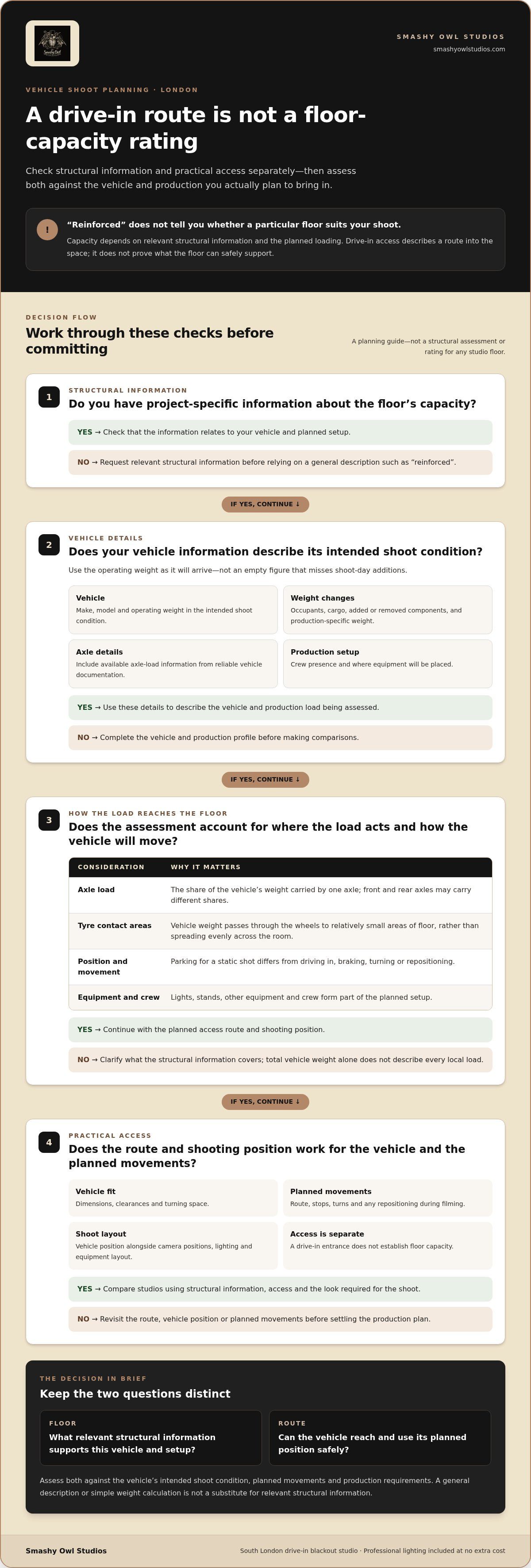
Use the table to organise your comparison, not as a substitute for technical assessment. A vehicle shoot studio London reinforced floor capacity decision should bring together relevant load documentation, a workable route, clearances and the actual production plan. Reviewing these together helps reveal gaps before the shoot is committed.
Planning a Vehicle Shoot: A Practical London Studio Checklist
Bring the vehicle, floor assessment and creative setup into one plan before booking. A clear brief helps identify what information is available, where the unknowns are and how the vehicle will move through the space. Use this sequence to organise your preparation.
Record the vehicle details. Note its make, model and operating weight in the condition it will arrive. Use reliable vehicle documents for weight and axle information instead of estimating from appearance.
Describe the full load. Record who will be inside the vehicle, any cargo, modifications or production additions, and equipment that will travel with it. These details can change the load compared with an unoccupied or standard vehicle.
Set out the intended movement. Specify whether the vehicle will be driven into position, repositioned during filming or kept stationary. Include turning, stopping or repeated movements in the plan.
Review structural information. Use verified, site-specific details relevant to the vehicle and its planned use. If interpreting floor capacity requires technical judgement, involve a competent structural professional. Don’t infer a safe load from a general description or access feature.
Map the route and layout. Plan arrival, entry, manoeuvring, the final parking position and the exit route. Add camera positions, lighting, equipment and crew pathways so the vehicle and production activity can work together safely.
Prepare vehicle and loading details before the shoot
Keep the information in one concise document. Attach or reference appropriate vehicle documentation, and distinguish the vehicle’s documented weight from any occupants, added equipment or other changes planned for the shoot. A simple movement outline can prevent assumptions: mark where the vehicle enters, where it stops, and whether it moves again once filming begins.
Map access and production logistics around the studio
Check the complete route against the vehicle’s dimensions and turning requirements, not just the entrance. Plan how the vehicle will be positioned in relation to lights, cameras, crew and equipment. In a blackout studio, professional lighting can help shape the visual look; Smashy Owl Studios includes professional lighting at no extra cost. Build lighting positions into the layout while keeping the access route and planned vehicle movement clear.
For more on planning a drive-in production space, read this guide to drive-in studio hire in London. A considered vehicle shoot studio London reinforced floor capacity plan pairs creative preparation with relevant structural information, vehicle details and a workable route.
Explore the South London drive-in blackout studio as a setting for your vehicle shoot, and use this checklist to shape your production plan.
Plan a Vehicle Shoot at Smashy Owl Studios in South London
A successful vehicle shoot brings together three plans: the vehicle’s loading details, the studio’s structural information and the production workflow. Smashy Owl Studios’ drive-in blackout studio in South London, near Oval, provides a practical setting for vehicle productions. Treat drive-in access as a logistical feature, not evidence of a particular floor capacity or vehicle suitability. Match the vehicle and intended use to relevant structural information as part of your planning.
A drive-in blackout studio for controlled vehicle visuals
A blackout environment gives your team control over the visual atmosphere, with professional lighting included at no extra cost to help shape the look. Plan lighting positions alongside camera angles, crew pathways and the vehicle’s final position, so the setup supports the shot without obstructing movement.
Drive-in access can simplify the vehicle’s route into the studio, but access and structural assessment are separate considerations. Include the vehicle’s make, model, operating weight, axle details and any occupants or added production load in your plan. Note whether the vehicle will stay parked or move during filming. These details help define the structural questions for the space without relying on assumptions about a floor rating, maximum vehicle weight or clearances.
Bring the production plan together in London
Before the shoot, bring the information into one clear brief:
Vehicle and load: document operating weight, axle information, occupants, modifications and equipment carried in the vehicle.
Structural suitability: use relevant, verified site information and competent structural assessment for load questions.
Access and movement: map arrival, entry, turning, shooting position and exit, including any movement during filming.
Production layout: place cameras, lighting and equipment, and plan crew pathways around the vehicle route.
This joined-up approach makes it easier to plan a vehicle shoot studio London reinforced floor capacity assessment alongside the creative setup. For a wider view of production-space planning, read the London film location hire guide.
Explore the Smashy Owl Studios spaces for your London vehicle shoot, and start shaping a production plan that brings the setting, vehicle and visual concept together.
Bring Your Vehicle Shoot Plan Into Focus
A strong vehicle production plan pairs verified structural information with the vehicle’s weight and loading details. It also accounts for the route, turning and intended movement, plus the position of lighting, equipment and crew. Drive-in access is valuable for logistics, but it isn’t a floor-capacity rating. Keep that distinction at the centre of your vehicle shoot studio London reinforced floor capacity assessment.
Smashy Owl Studios’ South London blackout studio, near Oval, offers drive-in access for vehicle shoots and professional lighting included at no extra cost. It’s a creative setting to consider as you bring the technical and visual sides of your production together.
Explore the Smashy Owl Studios spaces and plan how your vehicle, lighting and creative direction could work in the studio. Start planning your London vehicle shoot with Smashy Owl Studios.
Frequently Asked Questions
Can a vehicle shoot studio have drive-in access but an unknown floor rating?
Yes. Drive-in access describes a route for bringing a vehicle into a studio; it doesn’t state the floor’s structural capacity. Treat access and load suitability as separate planning questions. Compare relevant documented floor-loading information with the vehicle and planned shoot conditions. An unknown rating doesn’t prove the studio is unsuitable, but it also isn’t evidence that the floor can support your production.
How do axle loads affect a vehicle studio floor?
Axle load is the portion of a vehicle’s weight carried by one axle and transferred to the floor through its tyres. For example, a car’s front and rear axles may carry different shares of its weight, creating different loads at the tyre contact areas. Axle information helps describe distribution, but it isn’t a complete structural assessment. The vehicle, floor construction, position and movement all matter when evaluating a particular shoot.
What vehicle information should I prepare before planning a studio shoot?
Gather the vehicle’s make and model, reliable weight information, and axle details from appropriate documentation where available. Record planned changes, such as added equipment or cargo, and note how many people will be inside or working nearby. Explain whether the vehicle will stay parked or move during filming. This gives your planning team a clearer basis for considering loading requirements, the access route, turning space and shooting layout.
Does a reinforced floor automatically support any car?
No. “Reinforced” doesn’t describe a universal safe limit for every vehicle or production setup. Suitability depends on the floor’s documented specification and the loads it will experience. Vehicle weight, how that weight is distributed, movement and concentrated equipment loads may all be relevant. Don’t treat a general label as proof that a particular car can be accommodated. Use project-specific structural information to assess the planned vehicle, position and activity.
What should I check when planning vehicle access to a London studio?
Plan the full approach and entry sequence, not just the doorway. Consider the vehicle’s dimensions, turning requirements, route into the shooting area and final parking position. Map where crew, equipment and lighting will go, and include arrival and load-in in your London production schedule. Keep access planning separate from structural assessment: a route that works for the vehicle doesn’t establish the floor’s capacity to support it.
Is a blackout studio useful for car photography and filming?
A blackout studio can help create a controlled lighting environment and focused visual mood. This can be useful for reflective vehicle surfaces, where light placement shapes the image. Smashy Owl Studios’ South London blackout studio, near Oval, has drive-in access for vehicle shoots and professional lighting included at no extra cost. These features support production planning, but they don’t establish floor capacity or replace assessment of the vehicle route and structural information.
Does drive-in access mean a studio is suitable for my vehicle shoot?
Not by itself. Drive-in access can make vehicle logistics more practical, but suitability also depends on the vehicle, relevant floor-loading information, access route and production plan. Consider whether the vehicle will move, where equipment will be positioned, and how the crew will work around it. Assess these factors together while keeping access and structural capacity distinct. That gives you a clearer picture of what the shoot requires before finalising your plan.
Comments