

Vehicle Shoot Studio in London: How to Assess Reinforced Floor Capacity

Can a vehicle drive into a studio and still be too heavy for its floor? Drive-in access alone doesn't tell you what a floor can support, so vehicle shoot studio London reinforced floor capacity is worth thinking through before you book. This guide sets out what to gather and ask, and how to plan a vehicle shoot at Smashy Owl Studios.
Smashy Owl Studios is a location hire business near Oval station in Camberwell, SE5, with two spaces about 3 minutes' drive apart: the Shangri-La Penthouse and the Shangri-L'Arche Blackout Studio (the Arch). The Arch is our drive-in blackout studio. You hire the space by the hour, and bring your own team, including photographer, videographer, crew and driver.
For vehicle work, the Arch offers a fully blackout setting with drive-in vehicle access and lighting equipment provided. Drive-in access is an optional upgrade that must be requested before booking. Below we cover the vehicle, route and layout details to prepare.
Table of Contents
Choosing a Vehicle Shoot Studio in London: Why Floor Capacity Matters
A vehicle shoot needs more than a striking backdrop. The floor must suit the vehicle and production setup, and the route into position must work for the vehicle’s size and planned movements. Treat these as connected planning questions, but assess them separately: a straightforward entrance doesn’t establish what the floor can safely support.
Floor loading describes the load a floor is designed to support. For a shoot, consider how the vehicle's weight reaches the floor, where it will be positioned and whether it will move during filming. Lights, stands and other equipment also form part of the setup. The answer is specific to the project, not settled by a general label such as "reinforced".
What does reinforced floor capacity mean for a vehicle shoot?
Reinforcement refers to elements intended to strengthen a structure; capacity describes the loads that structure can safely support. The terms are related, but they aren’t interchangeable. A reinforced floor doesn’t, by itself, show whether it’s suitable for a particular vehicle or shooting arrangement.
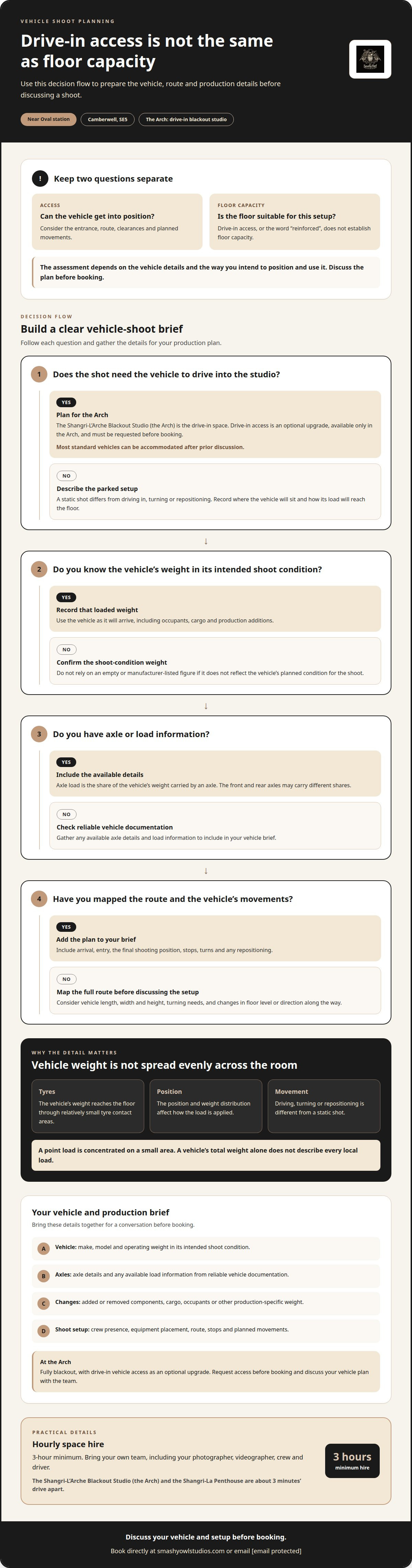
Consider a car on a studio floor. Its overall weight is one part of the picture, but that load is transferred through the tyres onto specific areas rather than spread evenly across the room. Driving into position is also a different situation from parking for a static shot.
For a reliable assessment, use the vehicle details and intended setup together, and talk them through with us before booking.
Why vehicle access does not prove floor capacity
Drive-in access describes a practical route into a space. It doesn't confirm that every vehicle is suitable. The vehicle's weight, how it's distributed across the tyres, and whether it will turn, stop or reposition all affect your plan.
The Shangri-L'Arche Blackout Studio (the Arch) offers drive-in vehicle access as an optional upgrade at our Camberwell, SE5 location. Drive-in access is available only in the Arch, must be requested before booking, and most standard vehicles can be accommodated after prior discussion. Plan the route alongside your camera positions, lighting and equipment layout.
Vehicle Weight, Axle Loads and Point Loads: The Details to Understand
A vehicle’s total weight is only the starting point for assessing how it loads a studio floor. Gross vehicle weight describes the vehicle’s total weight in the relevant loaded condition, including occupants, cargo and production additions. Record the weight for the vehicle as it will arrive, rather than relying on an empty or manufacturer-listed figure that may not reflect the shoot setup.
Axle load is the share of a vehicle’s weight carried by one axle. A point load is a load concentrated on a small area. A car’s weight passes through the axles to the wheels, then into the floor through the tyre contact patches. These loads are local, not evenly spread across the entire room. The front and rear axles may also carry different shares of the weight.
How vehicle weight is distributed across a studio floor
Tyres meet the floor over relatively small contact areas, so overall vehicle weight alone doesn't describe every local load. The vehicle's position, weight distribution and movement all matter, and a car parked for a static shot presents a different situation from one driving in, turning or repositioning. Record these details in your brief so the Smashy Owl Studios team can discuss your vehicle plan with you before you book.
What information helps assess a vehicle’s loading requirements?
Prepare a concise vehicle and production profile. Include:
Vehicle: make, model and operating weight in its intended shoot condition.
Axles: axle details and any available load information from reliable vehicle documentation.
Changes: added or removed components, cargo, occupants or other production-specific weight.
Shoot setup: crew presence, equipment placement and the vehicle’s planned route, stops and movements.
Describe the loading and positioning plan clearly. HSE material on safe loading offers context on managing vehicle loads and stability. Smashy Owl Studios is a location hire business in Camberwell, SE5, and our Shangri-L'Arche Blackout Studio (the Arch) is the space for drive-in vehicle shoots.
How to Compare Vehicle Shoot Studios in London Safely
Compare a space on three fronts: the structural information available, practical vehicle access and suitability for the look you want. A polished backdrop or a drive-in entrance supports the creative plan, but you will want to talk through your specific vehicle and setup before booking.
Floor documentation versus drive-in access
Floor-loading information helps establish what a floor is designed to support. A drive-in route shows that vehicle access is available, so keep the two questions distinct when comparing spaces.
The Arch offers drive-in vehicle access as an optional upgrade, with a minimum booking of 3 hours. See current rates on our website. It must be requested before booking, and most standard vehicles can be accommodated after prior discussion. Smashy Owl Studios hires out the space only, so you bring your own team.
Vehicle and production factors to compare
Map the full route, from arrival and entry to the final shooting position. Consider the vehicle’s length, width and height, turning needs, and any changes in floor level or direction along the way. Compare the route and clearances with the vehicle itself. Fitting through the entrance doesn’t necessarily mean there’s enough room to turn or position it as planned.
The production setup matters too. A stationary display has different movement requirements from a filmed sequence in which the vehicle drives, turns or repositions. Include camera positions, lighting stands, crew movement and equipment locations in your plan. Lighting equipment is provided in the Arch, and you are welcome to bring your own props, equipment and lighting too.
Use the table to organise your comparison. A sound vehicle shoot studio London reinforced floor capacity decision brings together load information, a workable route, clearances and your actual production plan.
Planning a Vehicle Shoot: A Practical London Studio Checklist
Bring the vehicle, route and creative setup into one plan before booking. Use this sequence to organise your preparation.
Record the vehicle details. Note its make, model and operating weight in the condition it will arrive, using reliable vehicle documents rather than estimates.
Describe the full load. Record who will be inside the vehicle, plus any cargo, modifications or production additions.
Set out the intended movement. Specify whether the vehicle will be driven into position, repositioned during filming or kept stationary.
Discuss the floor with us. Share your vehicle details when you enquire so we can talk through your plan before you book.
Map the route and layout. Plan arrival, entry, manoeuvring, the final position and the exit, then add camera positions, lighting and crew pathways.
Prepare vehicle and loading details before you hire
Keep the information in one concise document. Attach the relevant vehicle documentation, and distinguish the vehicle's documented weight from any occupants, added equipment or other changes planned for the shoot. A simple movement outline helps: mark where the vehicle enters, where it stops, and whether it moves again once filming begins. Smashy Owl Studios is a location hire business, so you hire the space and bring your own team.
Map access and production logistics around the studio
Check the complete route against the vehicle's dimensions and turning requirements, not just the entrance. Plan how the vehicle will sit in relation to lights, cameras, crew and equipment. Build your lighting positions into the layout while keeping the access route and the vehicle's movement clear.
For more on planning a drive-in production space, read our guide to choosing a photoshoot location in London. A considered vehicle shoot studio London reinforced floor capacity plan pairs creative preparation with vehicle details and a workable route.
Plan a Vehicle Shoot in the Arch at Smashy Owl Studios
For vehicle productions, the Arch is the space to consider. Drive-in access is an optional upgrade, so request it before booking. Treat it as a logistical feature, not evidence of a particular floor capacity.
The Arch: a fully blackout studio with drive-in access
The Arch is fully blackout, with lighting equipment provided, a neon runway, a golden throne, an aerial hoop and a fully working, tuned baby grand piano. You hire the space and bring your own photographers, filmmakers, crew and models. Plan lighting positions alongside camera angles, crew pathways and the vehicle's final position.
Access and structural assessment are separate considerations. Include the vehicle's make, model, operating weight, axle details and any occupants or added production load in your brief, and note whether the vehicle will stay parked or move during filming. Drive-in vehicle shoots in the Arch have a minimum booking of 3 hours; see current rates on our website.
Bring the production plan together
Before the shoot, bring the information into one clear brief:
Vehicle and load: document operating weight, axle information, occupants, modifications and equipment carried in the vehicle.
Structural suitability: use relevant, verified site information and competent structural assessment for load questions.
Access and movement: map arrival, entry, turning, shooting position and exit, including any movement during filming.
Production layout: place cameras, lighting and equipment, and plan crew pathways around the vehicle route.
This joined-up approach makes it easier to plan a vehicle shoot studio London reinforced floor capacity assessment alongside the creative setup. If you want two looks in one day, you can also split a shoot between the Arch and the Penthouse, with discounted rates when both are booked on the same day.
Bring Your Vehicle Shoot Plan Into Focus
A strong vehicle production plan pairs verified structural information with the vehicle's weight and loading details, the route and turning, and the position of lighting, equipment and crew. Drive-in access is valuable for logistics, but it isn't a floor-capacity rating.
Hire at Smashy Owl Studios is hourly, with no minimum booking. See the current rates on our prices page and the Arch page for details.
Frequently Asked Questions
Can a vehicle shoot studio have drive-in access but an unknown floor rating?
Yes. Drive-in access describes a route for bringing a vehicle into a studio; it doesn’t state the floor’s structural capacity. Treat access and load suitability as separate planning questions. Compare relevant documented floor-loading information with the vehicle and planned shoot conditions. An unknown rating doesn’t prove the studio is unsuitable, but it also isn’t evidence that the floor can support your production.
How do axle loads affect a vehicle studio floor?
Axle load is the portion of a vehicle’s weight carried by one axle and transferred to the floor through its tyres. For example, a car’s front and rear axles may carry different shares of its weight, creating different loads at the tyre contact areas. Axle information helps describe distribution, but it isn’t a complete structural assessment. The vehicle, floor construction, position and movement all matter when evaluating a particular shoot.
What vehicle information should I prepare before planning a studio shoot?
Gather the vehicle’s make and model, reliable weight information, and axle details from appropriate documentation where available. Record planned changes, such as added equipment or cargo, and note how many people will be inside or working nearby. Explain whether the vehicle will stay parked or move during filming. This gives your planning team a clearer basis for considering loading requirements, the access route, turning space and shooting layout.
Does a reinforced floor automatically support any car?
No. “Reinforced” doesn’t describe a universal safe limit for every vehicle or production setup. Suitability depends on the floor’s documented specification and the loads it will experience. Vehicle weight, how that weight is distributed, movement and concentrated equipment loads may all be relevant. Don’t treat a general label as proof that a particular car can be accommodated. Use project-specific structural information to assess the planned vehicle, position and activity.
What should I check when planning vehicle access to a London studio?
Plan the full approach and entry sequence, not just the doorway. Consider the vehicle’s dimensions, turning requirements, route into the shooting area and final parking position. Map where crew, equipment and lighting will go, and include arrival and load-in in your London production schedule. Keep access planning separate from structural assessment: a route that works for the vehicle doesn’t establish the floor’s capacity to support it.
Is a blackout studio useful for car photography and filming?
A blackout studio can help create a controlled lighting environment and a focused visual mood. This can suit reflective vehicle surfaces, where light placement shapes the image. The Shangri-L'Arche Blackout Studio (the Arch) is fully blackout and has drive-in vehicle access as an optional upgrade, requested before booking. Lighting equipment is provided in the Arch. These features support production planning, but they don't replace assessment of the vehicle route and structural information.
Does drive-in access mean a studio is suitable for my vehicle shoot?
Not by itself. Drive-in access can make vehicle logistics more practical, but suitability also depends on the vehicle, relevant floor-loading information, access route and production plan. Consider whether the vehicle will move, where equipment will be positioned, and how the crew will work around it. Assess these factors together while keeping access and structural capacity distinct. That gives you a clearer picture of what the shoot requires before finalising your plan.
The Arch is our fully blackout studio with drive-in vehicle access, available as an optional upgrade that must be requested before booking. Hire is hourly with no minimum booking, and you bring your own team. To book, visit smashyowlstudios.com or email bookings@smashyowlstudios.com.
Comments