

Hourly photo studio booking vs paying 10-hour day rates London
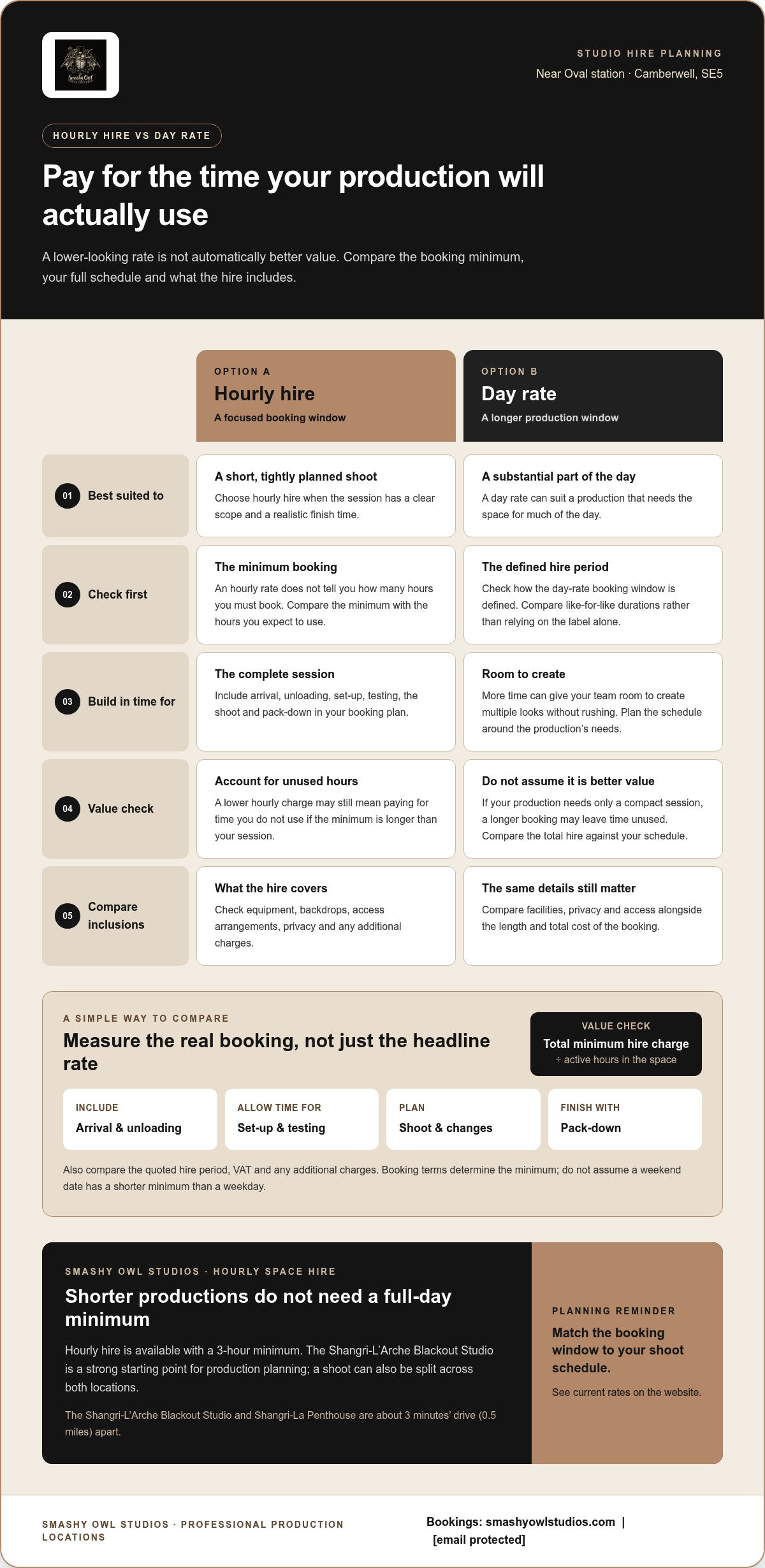
The cheapest-looking option can cost more once setup, pack-down and unused hours are counted. For hourly photo studio booking versus paying a 10-hour day rate in London, choose hourly hire for a short, tightly planned shoot; a day rate can suit a production that needs the space for a substantial part of the day.
It’s easy to assume a day rate offers better value, especially for commercial photography. But the real comparison is the time you’ll use, the studio’s minimum booking, and what the hire fee covers. Equipment, backdrops, parking and exclusive use can all shape the value.
This guide explains how to weigh hourly, half-day and day-rate hire, what to factor into your shoot schedule, and how to compare inclusions and privacy. You’ll also see when a focused few-hour booking makes sense, and when more time in the studio gives your team room to create multiple looks without rushing.
Table of Contents
What does it cost to book affordable photo studios in London?
Compare the minimum booking and total hire period, not just the advertised hourly rate. The right format depends on your shoot’s needs, including time for preparation and pack-down.
Hourly rates and booking minimums
An hourly rate doesn’t show how many hours you must book. Calculate the minimum hire period first, then compare it with your planned session. In a London studio index dated 12 September 2026, 85% of studios stating a minimum wouldn’t accept a one-hour booking. Two hours was the most common minimum, around a quarter required four hours or more, and the longest minimum was ten hours.
Location and travel also shape value. A space closer to your crew, models and equipment can reduce travel time and transport costs, even if its minimum booking is longer. Consider the full production schedule, including arrival, unloading and access, rather than judging a studio by its hourly charge alone.
Weekday and weekend hire periods
Compare the minimum booking and hourly rate for each possible date. A lower rate may come with a longer minimum, leaving time unused; a higher rate with a shorter minimum may suit a compact shoot better. Record the minimum, the hours you expect to use and the time needed for set-up and pack-down.
Don’t assume a weekend date comes with a shorter minimum hire period. The booking terms determine the minimum, while the day of the week may affect the rate. Treat these as separate details when planning. Compare the complete hire period for your chosen date, rather than relying on a weekday or weekend label to indicate value.
Effective cost of minimum bookings
Work out the effective cost by dividing the total minimum hire charge by the hours you’ll actively use the space. If a booking requires four hours but the shoot itself takes two, consider whether the remaining time can be used for set-up, wardrobe changes or pack-down. Around a quarter of London studios in the index required a minimum of four hours or more.
Travel may change that calculation. A more distant studio can add crew travel time and transport costs, while a closer location may make a longer booking more practical. Cancellation, deposit and rescheduling terms are set out in each studio’s booking conditions. Read those terms alongside the hire window so you understand the commitment if production dates change.
Included equipment and privacy when comparing studios
A short booking can be efficient when the space already suits your production, but the hire fee alone won’t show what you’ll need to bring. Compare the actual inclusions, access arrangements and privacy terms. A lighting setup, backdrop or studio manager may be included in one hire and charged separately in another.
List the equipment your shoot needs
Start with a production list, then match each item against the studio’s published hire details. For a portrait shoot, that might mean lighting, a backdrop and space for the photographer’s kit. A product shoot may need a clear surface, power access and room to style several items. Mark each requirement as included, separately charged or brought by your team.
Look beyond the word “equipped”. It doesn’t tell you which lighting or backdrops are available, or whether the listed items suit your camera setup. Note the equipment names and quantities in the hire information, then plan your shot list around those details. This helps prevent a short booking being stretched by avoidable equipment changes.
Factor set-up and support into short hire
For a compact session, equipment placement and testing can take a meaningful part of the booked time. Allow for unloading, setting lights, checking exposure and packing down. A studio manager can be useful for practical access or space-related support, but that role doesn’t automatically mean a lighting technician or production crew is provided. Keep responsibilities clear in your team plan.
Separate the studio’s fixed features from the equipment your team needs to bring. Make a simple list before booking: what comes with the space, what your crew will bring and whether any extra charges apply. This gives your production lead a clear basis for planning.
Compare privacy and access arrangements
Privacy can affect how smoothly a shoot runs, particularly for wardrobe changes, confidential brand work or interviews. Check whether the space is exclusive to your booking and how people access the location. An exclusive room may suit a client review, while a shared facility may require tighter scheduling around arrivals and changes.
Also consider who can enter during the hire and where equipment can be stored between set-ups. These details can determine whether a short session feels practical or rushed. Compare the hire terms with your call sheet, arrival plan and shot list before choosing the booking length.
For a production with particular access or privacy needs, discuss your shoot requirements as part of planning the space.
London photography studio hourly prices
London studios offer hourly hire and longer booking blocks, but the format alone doesn’t show value. Compare the terms with your production plan and the facilities it needs.
Hourly hire price benchmarks
There isn’t one average 10-hour day rate that represents London photo studios consistently. The total depends on the space, location, facilities, booking terms and whether the quoted rate includes VAT. Compare studios using the same booking duration and check how the hire period is defined. A headline hourly rate can be misleading if it doesn’t reflect the hours your production must book.
For a short session, work out how much of the booked time will go to photography, filming, preparation and pack-down. Then factor in any additional charges. This gives you a more realistic comparison than the hourly rate alone, especially when spaces offer different facilities or access.
Studio-specific hourly and day-block rates
Use Studio A and Studio B as labels in your own comparison. For each, record the hourly rate, minimum booking, longer-block terms and any separate charges. Calculate the total for the time your production needs, then note whether any hours would go unused.
Compare the practical fit as well as the terms. One space may better suit a short portrait session, while another may support a longer campaign with several looks. Note requirements such as an infinity cove, parking or access for filming, and whether each is part of the hire. See current rates on the relevant studio’s website before making a budget.
Average ten-hour day-rate comparison
To compare a 10-hour booking, set the complete day-block charge beside the total cost of booking the same period hourly. Include minimums, additional facility charges and VAT treatment in both calculations. This creates a like-for-like comparison without assuming that a day rate is automatically the better-value choice.
Map the booked hours against your production schedule. Multiple set changes, a larger team or a tightly sequenced shot list may make a longer block worthwhile, while a single-look session may leave time unused. Include arrival, set-up, shooting, breaks and pack-down, then compare the booking formats with the time your team genuinely needs.
Finally, judge the booking by what supports the shoot. Confirm whether parking and required facilities are available, and consider whether the space suits photography, filming or both. A clear schedule and an itemised comparison make it easier to choose a booking format that fits the production.
Commercial photography half-day rates
A commercial half-day can suit a focused brief, but the label doesn’t define the time or facilities included. Separate the photographer’s fee from studio hire, then compare what each covers. For commercial teams choosing hourly photo studio booking versus a 10-hour day rate in London, the brief and production schedule should lead the decision.
Photographer fees and studio hire are separate parts of a commercial shoot budget. If you’re hiring a space and bringing your own photographer, account for each independently. This clarifies the full production cost and helps you decide whether a shorter booking gives the team enough time to deliver the agreed images.
Decide what the half-day needs to achieve
Begin with the brief. Photographing a product range against one backdrop may take less time than a campaign with talent, several products and set changes. List each scene, who needs to be present and what must be reset. Allow time for arrivals, lighting checks, shooting and pack-down within the booking.
For example, a team capturing one consistent look can group similar products together. A fashion campaign with outfit changes needs time for transitions as well as photography. If the brief calls for both controlled light and daylight, decide which images need each setup before choosing the hire period.
Match the space to the brief
Facilities influence how a half-day runs. A blackout space lets the crew control ambient light, whilst an infinity backdrop can create a clean, seamless background. Choose the setting that supports the planned images, rather than adding a feature that won’t appear in the final work.
Write down requirements before booking: background, lighting, access, privacy and room for the team. Confirm what the studio hire includes and what your crew must bring. For hourly photo studio booking compared with a 10-hour day rate in London, this checklist helps clarify whether extra time would support the production.
Choose between a half-day and a full day
A shorter booking can work well when the shot list is contained and the team has a prepared schedule. A longer session may suit a commercial production with several setups, multiple stakeholders or more deliverables. Compare the extra hire time with the work it enables, rather than relying on the booking label alone.
Ask the production lead to map the schedule from arrival to pack-down. Put essential images first, followed by optional shots. If the core work fits comfortably, a shorter booking may be practical. If the plan depends on multiple changes, more studio time can protect the schedule and give the team room to work.
Smashy Owl Studios: Photo studio hire london
Smashy Owl Studios offers photography and film location hire near Oval station in Camberwell, SE5, with hourly bookings and a 3-hour minimum rather than a full-day minimum. The fully blackout Arch is a strong fit for controlled lighting, music videos and productions needing drive-in vehicle access. Its stage, baby grand piano and distinctive set features give creative teams options for varied looks.
For a different visual direction, the Shangri-La Penthouse brings luxury interiors and panoramic London skyline views. The two spaces are about 0.5 miles apart, so a shoot can move between contrasting locations. You bring your own photographers, filmmakers and crew; after a booking is confirmed, Bella can recommend independent creatives who are booked directly by you.
See current rates and book at smashyowlstudios.com, or email bookings@smashyowlstudios.com.
Shape your booking around the work
The decision between an hourly photo studio booking and paying 10-hour day rates in London should start with the images your production needs, not the clock alone. Turn your brief into a practical shoot plan: list the essential shots, identify changes in location or setup, and decide what your team needs from the space to make each frame work.
A clear plan gives you a better basis for choosing a booking length and setting out your production requirements. It also helps your photographer, crew and other independent creatives share priorities, so the time in the studio supports the work rather than last-minute decisions.
Bring your idea, visual references and preferred shoot dates to your booking. A considered plan can simplify the process and leave more room for the creative work ahead.
Give your next shoot the space and focus to take shape.
Frequently Asked Questions
Can I Hire a Film Studio for Just a Few Hours?
Yes, some London film studios offer hourly hire, although minimum booking periods apply. Smashy Owl Studios offers hourly hire with a 3-hour minimum, which can suit a focused interview, product sequence or short filming session. For vehicle shoots, drive-in access has its own 3-hour minimum booking. Plan your arrival, setup and pack-down alongside filming, so the time you book fits the full production schedule.
Do hourly clients get the same level of service?
Hourly studio hire reserves the space for a set period; it isn’t a photography or film-production package. Your own photographer, filmmaker and crew plan and run the shoot. Check the studio’s hire information for included features, then prepare a call sheet with arrival times, responsibilities and set-up needs. A small interview team, for example, may need a different arrival plan from a fashion crew changing looks.
Hourly Hire vs Full Day Booking: What’s the Difference?
Hourly hire charges for a defined number of hours; a day booking reserves a longer block. The practical difference is how much time your production needs for set-up, shooting and changes. A brief interview with one camera setup may fit a shorter session. A campaign involving multiple scenes, talent or product changes may need a longer block to avoid compressing the schedule.
Hourly, half day or full day: which is cheaper per hour?
A longer booking may have a lower effective hourly cost, but its total charge can still be higher. Divide the hire cost by the hours booked to compare the effective rate, then consider whether your production will use the extra time. A longer block may be better value than hourly hire when several planned setups make use of those hours.
How does the short session booking process work?
Choose the space and outline your shoot, preferred date, session length and access needs. Then book the studio and organise your own photographer, crew and creative team. Before shoot day, share the schedule and shot list with everyone involved. For drive-in vehicle access at Shangri-L’Arche, request it before booking so suitability can be confirmed.
What is the average hourly photo studio hire rate in London?
There isn’t one average rate that represents every London photography studio or type of hire. The hourly charge depends on the space, location, facilities and booking terms. Compare like with like: use the same session length, note what the hire includes and calculate the total for your planned hours. See Smashy Owl Studios’ current rates on the website.